GIGABYTE RTX 5070 AERO OC: White Elegance, Absolute Power
GIGABYTE's AERO series is the dream of any content creator or gamer looking to build an aesthetically perfect all-white PC. Inspired by the serenity of water and ice, its chassis and metal backplate combine matte and mirrored finishes with customizable RGB Fusion lighting, creating waves of light that flow with the rotation of its fans.
Blackwell Architecture and New GDDR7 Memory
Powered by the new GeForce RTX 50 series, this model takes a brutal generational leap. It incorporates 12 GB of the new GDDR7 memory operating at an astonishing speed of 28 Gbps, ensuring massive bandwidth. By adding NVIDIA DLSS 4 technology featuring multi-frame generation and ray reconstruction, you will achieve framerates (FPS) that seemed impossible at 4K resolution with maxed-out Ray Tracing.
WINDFORCE 3X Cooling: The Cold of the Hawk
To tame the GB205 chip, GIGABYTE has integrated its legendary three-fan WINDFORCE system. This "Hawk" version optimizes aerodynamics to push air with extreme force while barely making a whisper:
- Alternate Spinning: The central fan rotates in the opposite direction to reduce turbulence and guide hot air exhaust smoothly.
- 3D Active Fan: Enjoy total silence in desktop mode or light gaming; the fans stop completely.
- Server-Grade Thermal Gel: A special non-flowing compound that doesn't deform over time, ensuring memory chips (VRAM) and power phases (MOSFETs) transfer their heat perfectly to the composite copper heat pipes.
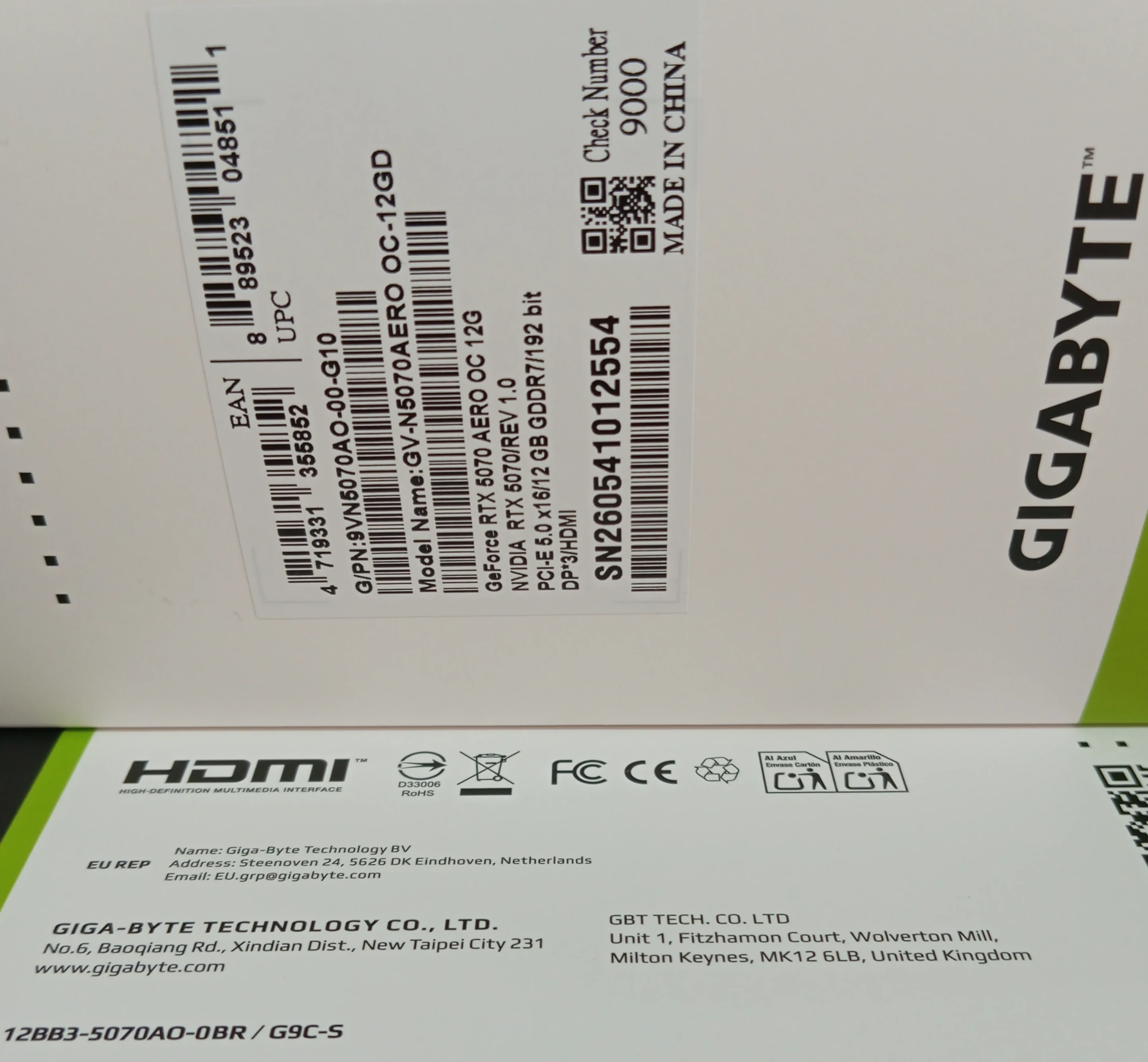
Technical Specifications (GV-N5070AERO OC-12GD)
| Feature | Detail | | :--- | :--- | | **GPU** | NVIDIA GeForce RTX 5070 (Blackwell Architecture) | | **CUDA Cores** | 6144 | | **Core Clock** | Boost: 2625 MHz (Reference card: 2512 MHz) | | **Memory (VRAM)** | 12 GB GDDR7 | | **Memory Clock** | 28 Gbps | | **Memory Bus** | 192-bit | | **Bus Interface** | PCI Express 5.0 x16 | | **Output Ports** | 1x HDMI 2.1b, 3x DisplayPort 2.1a (Supports up to 4 monitors) | | **Maximum Resolution** | 7680 x 4320 pixels (8K) | | **Dimensions** | L: 324 mm x W: 130 mm x H: 56 mm (2.7 Slots) | | **Power Requirements** | 750 W PSU recommended (1x 16-pin 12V-2x6 connector) *Adapter included* | | **Extras** | Dual BIOS (Performance / Silent Mode), Reinforced VGA support bracket |
Total Protection and Control
The graphics card features Dual BIOS technology, allowing you to switch between a maximum performance profile or a silence-focused one with just the flick of a switch. Furthermore, forget about GPU sag bending your motherboard: GIGABYTE includes a versatile VGA bracket in the box to keep the card perfectly straight. All of this is controllable from the GIGABYTE CONTROL CENTER (GCC) software.